
Stepping Stones
Movement
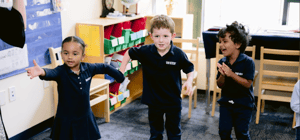
Movement class has been a hub of creativity and joyful learning as students discover the many ways their bodies can move. Through imaginative play and music, children are building coordination, confidence, and communication skills. We began by exploring shapes with our bodies, using poses like "child’s pose" and "plank" to develop spatial awareness. During our Circle Walk, children held hands and worked as a team, strengthening their balance and sense of connection as a group.
As we progressed, students practiced log rolls and crab poses to build core strength and the ability to follow multi-step instructions. We also introduced the concept of levels, where children explored moving close to the ground and reaching up high. To support rhythm and early literacy, toddlers practiced "Slow, Slow, Quick, Quick, Slow" patterns with their legs, matching their movements to the tempo of the words.
Sensory tools like ribbons and scarves have been essential for connecting music to motion. Children matched their movements to musical pitch and practiced tossing and catching to improve hand-eye coordination. We also used our Circle Stretch to learn the names of body parts, from ankles to elbows, discovering how each part moves independently. Throughout all these activities, students have focused on finding and respecting their personal space, learning to move safely and confidently among their peers.
Spanish
This term, children have been immersed in playful, language-rich experiences designed to build a natural familiarity with Spanish. We began by introducing foundational greetings like hola, buenos días, and adiós, helping students feel comfortable communicating from the very start. Through songs, books, and play-based activities, these everyday words have become a joyful part of our classroom routine.
Immersion is at the heart of our approach. Students hear and repeat Spanish as they engage with classroom materials, allowing them to build understanding through context. Whether working individually or in small groups, they are encouraged to listen to the language and use new vocabulary during their chosen tasks. This consistent repetition supports early language development and listening skills.
As the season progressed, the children continued to expand their vocabulary by pairing new words with hands-on activities they enjoy. By connecting language to physical action in a warm, encouraging environment, our learners are developing the confidence to explore a second language with curiosity and enthusiasm.
Music
This term, children explored the joy of singing and rhythm through playful, hands-on activities. Each class began with vocal warm-ups, where students used Curwen hand signs to connect pitches like "La" and "Ohhh" with physical movement. Songs such as “Shoo Fly” and “Oh! What A Day” encouraged children to pair singing with motion, fostering coordination and musical expression.
Call-and-response chants, like “Chop Chop Chippity Chop,” and various story songs helped students develop listening skills and rhyme recognition. We also used scarves to explore musical dynamics, allowing children to interpret loud and soft sounds through movement. Creative play with bells and rhythm sticks further strengthened gross motor skills as students experimented with different sounds.
Seasonal favorites like “Five Little Pumpkins” and “Dulce Dulce” added excitement while reinforcing rhythm and coordination. Throughout the season, our learners have built immense confidence and discovered the joy of expressing themselves through music.
Primary
PE
It has been an active start to the school year, filled with skill-building and fun in PE. Students have explored a variety of activities designed to develop coordination, teamwork, and a love for staying active. We kicked off the term with a soccer unit focused on foundational skills like dribbling, passing, and shooting. Beyond the ball work, we emphasized movement, spatial awareness, and the importance of good sportsmanship.
Students also practiced the mechanics of rolling and throwing. By adjusting their body positions to knock down target pins, they built essential hand-eye coordination and control. This energy carried over into Field Day, where the whole school came together to enjoy diverse activity stations and teamwork-based challenges.
Our adventure and gymnastics units allowed for even more creative movement. Using large foam blocks, students practiced lifting, stacking, and building to improve gross motor strength and problem-solving. At our gymnastics stations, children built confidence by balancing on beams, climbing over soft obstacles, and navigating tunnels. It has been a wonderful season of growth, and we look forward to even more movement and fun in the months ahead!
Spanish
This term, children have been immersed in playful, language-rich experiences designed to build a natural familiarity with Spanish. We began by introducing foundational greetings like hola, buenos días, and adiós, helping students feel comfortable communicating from the very start. Through songs, books, and play-based activities, these everyday words have become a joyful part of our classroom routine.
Immersion is at the heart of our approach. Students hear and repeat Spanish as they engage with classroom materials, allowing them to build understanding through context. Whether working individually or in small groups, they are encouraged to listen to the language and use new vocabulary during their chosen tasks. This consistent repetition supports early language development and listening skills.
As the season progressed, the children continued to expand their vocabulary by pairing new words with hands-on activities they enjoy. By connecting language to physical action in a warm, encouraging environment, our learners are developing the confidence to explore a second language with curiosity and enthusiasm.
Chinese
This term, students explored Chinese vocabulary through movement, play, and hands-on activities. We began by learning animal names like kitten, puppy, and bear, using flashcards paired with actions to connect words with meaning. To reinforce verbs like "walk," "run," and "jump," children practiced whole-body motions that made language learning a physical experience.
The curriculum also introduced colors such as red, blue, and green, which students identified using interactive building blocks. As the season progressed, we added "fish" and "rabbit" to our animal vocabulary alongside new action verbs like "turn" and "stop." These were practiced through movement games that brought the language to life.
In addition to spoken words, children were introduced to their first Chinese characters: the numbers one, two, and three. This early exposure supports visual memory and pre-literacy skills. Our students have shown wonderful enthusiasm as they explore animals, colors, and characters in this interactive environment.
Music
This term, Primary music classes focused on building strong foundations through singing, rhythm, and literacy. Students began each session with vocal warm-ups and Curwen hand signs, which help connect pitch recognition with physical coordination. By singing songs like “Red Red Robin” and “Sail Away Ladies,” children explored musical dynamics, learning to distinguish between loud (forte) and soft (piano).
Students also practiced musical forms such as ABA and ACA, using sticks, bells, and scarves to interpret rhythms and respond creatively to sound. These activities, alongside call-and-response songs, strengthened listening skills and pattern recognition. Movement exercises further helped students connect music to body awareness and active participation.
The season featured festive highlights, including the "Pumpkin Patch" chant and various themed songs that combined rhythm and movement. Through these expressive activities, students have grown in confidence and developed a genuine love for musical exploration.